Maa Kushmanda Prompt – Navratri Day 4 Gemini AI Photo Prompts
G
By Gulshan Aggarwal·
1. Full Pandal Maa Kushmanda Prompt
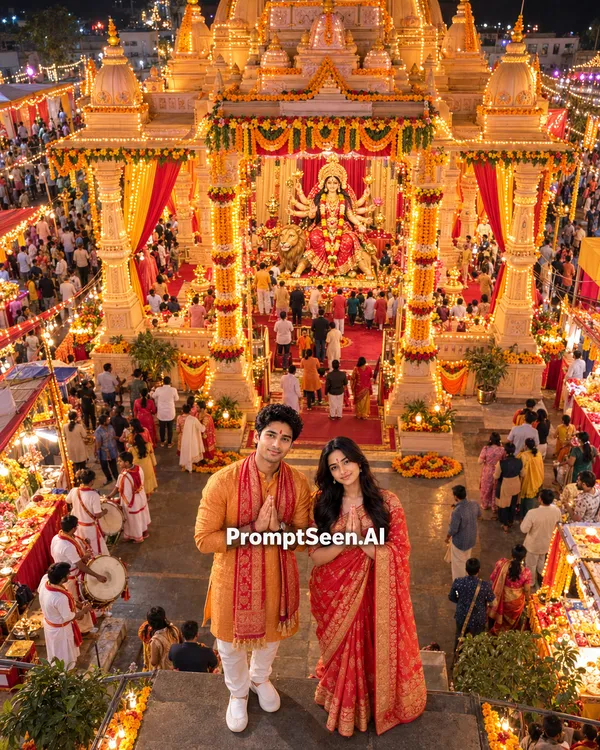
Experience the grandeur of a community Durga Puja celebration. This Navratri Day 4 Gemini AI photo prompt uses a spectacular aerial drone perspective to capture you standing in devotion before an enormous, brilliantly illuminated temple pandal.
Using the uploaded photo, keep the person's face, facial features, skin tone, hairstyle and body shape exactly the same. Do not alter the face in any way.
Create a realistic aerial drone photograph of a grand, magnificent Navratri pandal of Maa Kushmanda in India at night. The drone is at a medium height, about 10 to 15 metres up, angled down toward the pandal entrance.
The pandal is huge and richly crafted, shaped like a traditional Indian temple with tall carved domes and pillars, decorated with thousands of warm golden and orange lights, marigold garlands and colourful fabric. Through the wide main entrance, the large clay idol (pratima) of Maa Kushmanda is clearly visible inside: eight-armed, seated on a lion, wearing a red and golden saree and a gold crown, lit by warm lamps.
In the foreground, on the pathway in front of the entrance, the person from the uploaded photo stands facing the camera and looking up toward the drone with folded hands and a joyful, devoted expression. They wear traditional Indian festive attire in orange, red or yellow tones. Their face is clearly visible and sharp.
Around the pandal, crowds of devotees in traditional clothes, food and flower stalls, string lights across the street, and a few dhaak drummers create a lively festival atmosphere. The crowd is natural and slightly softer in focus than the person.
Photography style: real DJI drone photo, high-angle view, natural night lighting from the pandal lights, true-to-life colours, rich detail, documentary festival photography look. Vertical 4:5 frame.
Avoid: glowing aura, halos, light beams, fantasy or divine effects, cartoon or animated look, CGI, distorted crowd faces, over-smoothed skin.
2. Maa Kushmanda Sandhya Aarti Photo Prompt
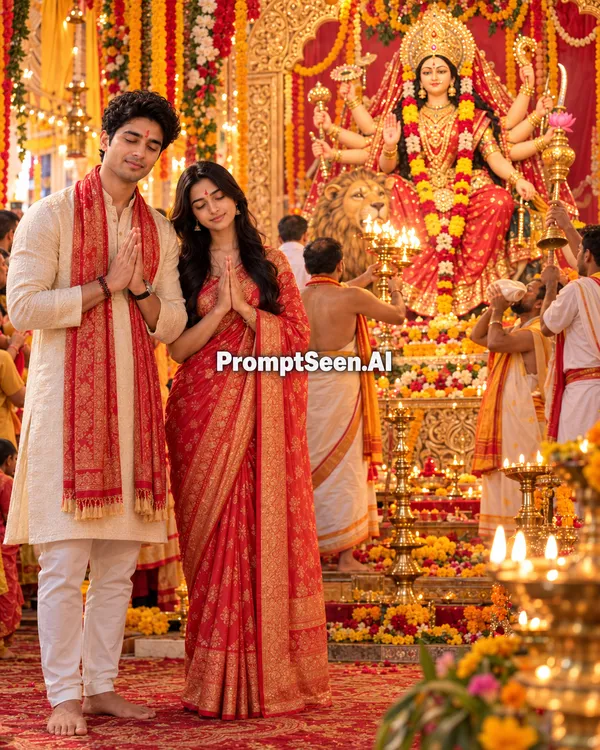
Immerse yourself in the sacred evening rituals. This Maa Kushmanda AI photo prompt frames you candidly participating in the Sandhya Aarti, illuminated by the warm, authentic glow of traditional brass lamps and fragrant dhoop smoke.
Using the uploaded photo, keep the person's face, facial features, skin tone, hairstyle and body shape exactly the same. Do not alter the face in any way.
Create a realistic, candid photograph of this person attending the evening sandhya aarti of Maa Kushmanda at a beautifully decorated Navratri pandal in India. The person stands in the foreground in a slight three-quarter angle toward the camera, hands folded in prayer, eyes softly half-closed in deep devotion, with a peaceful expression. They wear traditional Indian festive attire (a silk kurta or saree in warm orange, red or yellow tones) with a red tilak on the forehead. The person is barefoot, with no shoes, sandals or slippers, as per Indian tradition in front of the deity.
Behind them stands a large, handcrafted clay idol (pratima) of Maa Kushmanda: eight-armed, seated on a lion, holding a kamandal, bow, arrow, lotus, amrit kalash, chakra, gada and japa mala, wearing a red and golden saree, a red chunri, a gold crown and traditional jewellery, decorated with fresh marigold garlands.
In front of the idol, a priest (pujari) in a traditional dhoti and angavastram, with a tilak on his forehead, performs the aarti, raising a large brass multi-flame aarti lamp (panch-aarti) in a circular motion. Beside him, another priest blows a conch shell (shankh) and a devotee rings a brass bell. Fragrant smoke from dhoop and incense rises gently through the warm lamplight. Brass diyas, flowers and a puja thali are placed near the idol. A few devotees with folded hands are visible in the background, softly blurred. The priests and all devotees near the idol are also barefoot.
Photography style: shot on a DSLR with a 50mm lens at f/2.0, lit only by the warm flames of the aarti lamp and diyas, visible smoke catching the light, shallow depth of field, sharp focus on the person's face, the idol and the aarti clearly visible behind them. Natural skin texture, true-to-life colours, documentary festival photography look. Vertical 4:5 frame.
Avoid: glowing aura, halos, light beams, fantasy or divine effects, cartoon or animated look, CGI, over-smoothed skin, extra fingers, distorted hands, shoes, sandals, slippers or any footwear.
3. Maa Kushmanda Ghar Ka Mandir Photo Prompt
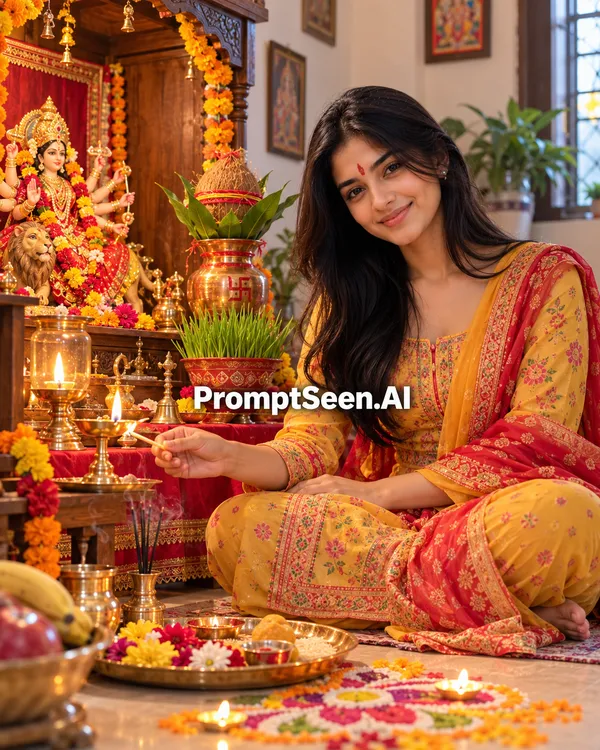
Celebrate simplicity and deep faith. This Navratri prompt for boys and girls creates an intimate, homely setting where you are gently lighting the Akhand Jyoti before a beautifully adorned home shrine.
Using the uploaded photo, keep the person's face, facial features, skin tone, hairstyle and body shape exactly the same. Do not alter the face in any way.
Create a realistic, candid photograph of this person performing Navratri puja for Maa Kushmanda in the small home temple of a simple Indian household. The person sits on a small asan on the floor in front of the home mandir, in a slight three-quarter angle toward the camera, gently lighting a brass diya with a matchstick or a small lamp, with a calm, devoted smile. Their face is clearly visible and softly lit by the diya flame. They wear simple traditional Indian clothes (a cotton or silk kurta or saree in yellow, orange or red tones) with a red tilak on the forehead. The person is barefoot, with no shoes, sandals or slippers, as per Indian tradition in front of the deity.
The home mandir is set on a wooden chowki covered with a red cloth. On it sits a small idol (pratima) of Maa Kushmanda: eight-armed, seated on a lion, dressed in a tiny red and golden chunri with small marigold garlands. Beside the idol is the Navratri kalash sthapana: a brass or copper kalash with mango leaves and a coconut wrapped in red cloth and tied with mauli, placed on a clay pot with green barley (jau) sprouts. An akhand jyoti burns steadily in a brass lamp with a glass cover. Around them are a puja thali with roli, rice, flowers and sweets, a few incense sticks, a small bell, and a simple rangoli on the floor in front of the mandir.
The setting is an ordinary Indian home: a plain painted wall, a small window with soft evening light, a few framed pictures of deities, nothing luxurious or staged.
Photography style: shot on a DSLR with a 35mm lens at f/2.0, warm natural light from the diyas and akhand jyoti mixed with soft window light, shallow depth of field, sharp focus on the person's face, the idol, kalash and akhand jyoti clearly visible. Natural skin texture, true-to-life colours, simple and homely documentary look. Vertical 4:5 frame.
Avoid: glowing aura, halos, light beams, fantasy or divine effects, cartoon or animated look, CGI, luxury or overly decorated interiors, over-smoothed skin, extra fingers, distorted hands, shoes, sandals, slippers or any footwear.
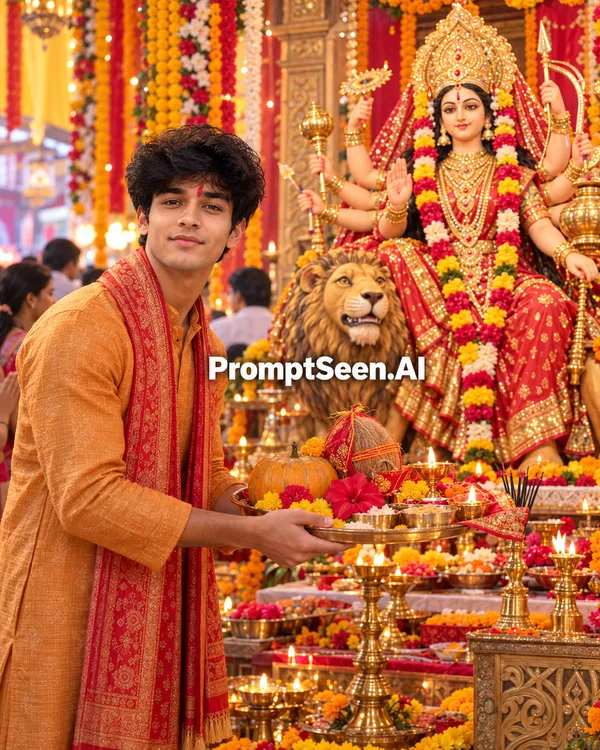
Offer your heartfelt devotion. This Maa Kushmanda photo editing prompt generates a highly detailed scene where you are presenting a large brass Bhog Thali—complete with malpua and a whole pumpkin—directly to the Ashtabhuja Devi idol.
Using the uploaded photo, keep the person's face, facial features, skin tone, hairstyle and body shape exactly the same. Do not alter the face in any way.
Create a realistic, candid photograph of this person offering bhog to Maa Kushmanda at a beautifully decorated Navratri pandal in India. The person stands in front of the idol, slightly bent forward, holding a large decorated brass puja thali with both hands and offering it toward the deity. They are in a slight three-quarter angle toward the camera, with a gentle, devoted smile, and their face is clearly visible. They wear traditional Indian festive attire (a silk kurta or saree in warm orange, red or yellow tones) with a red tilak on the forehead. The person is barefoot, with no shoes, sandals or slippers, as per Indian tradition in front of the deity.
The brass thali is neatly arranged with a small whole pumpkin (kaddu), a coconut wrapped in red cloth and tied with mauli, a folded red chunri with golden border, fresh marigold and red hibiscus flowers, a small bowl of malpua, roli, rice, and a lit brass diya.
Behind the thali stands a large, handcrafted clay idol (pratima) of Maa Kushmanda: eight-armed, seated on a lion, holding a kamandal, bow, arrow, lotus, amrit kalash, chakra, gada and japa mala, wearing a red and golden saree, a red chunri, a gold crown and traditional jewellery, decorated with fresh marigold garlands. At the foot of the idol are other offerings, brass diyas and incense sticks with soft smoke. A few devotees are visible in the background, softly blurred, and they are also barefoot.
Photography style: shot on a DSLR with a 50mm lens at f/2.0, natural warm pandal lighting from diyas and lamps, shallow depth of field, sharp focus on the person's face and the bhog thali, the idol clearly visible and detailed behind them. Natural skin texture, true-to-life colours, documentary festival photography look. Vertical 4:5 frame.
Avoid: glowing aura, halos, light beams, fantasy or divine effects, cartoon or animated look, CGI, over-smoothed skin, extra fingers, distorted hands, shoes, sandals, slippers or any footwear.
5. Maa Kushmanda Mala Arpan Candid Photo Prompt
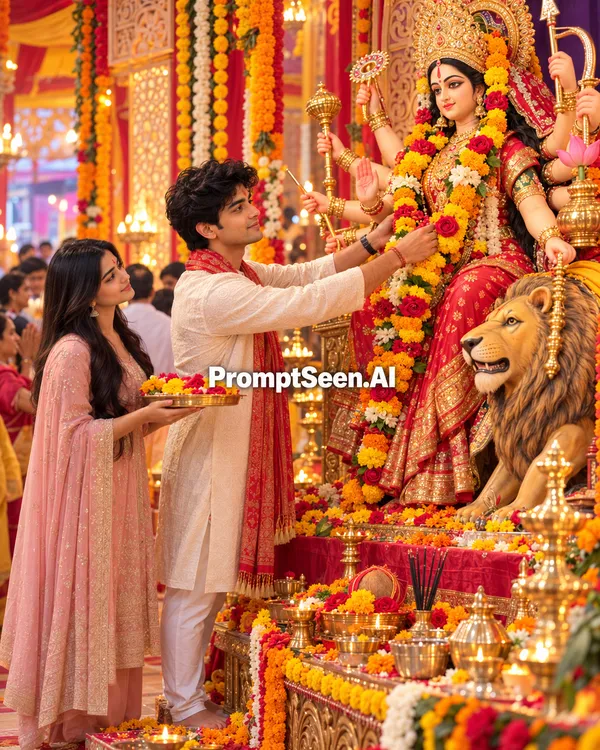
Capture an unposed, documentary-style moment of offering. This Navratri prompt in english positions the camera slightly to the side, framing you naturally as you place a thick marigold garland around the radiant idol.
Using the uploaded photo, keep the person's face, facial features, skin tone, hairstyle and body shape exactly the same. Do not alter the face in any way.
Create a realistic, candid photograph of this person offering a flower garland to Maa Kushmanda at a beautifully decorated Navratri pandal in India, captured naturally as if by a photographer standing to the side, without the person posing for the camera. The person stands on the low step of the idol's platform, reaching forward with both hands to gently place a thick, fresh garland of orange and yellow marigolds with a few red roses onto the idol. Their face is seen in a clear three-quarter profile, looking up at the deity with a soft, devoted smile and full concentration. They wear traditional Indian festive attire (a silk kurta or saree in warm orange, red or yellow tones) with a red tilak on the forehead. The person is barefoot, with no shoes, sandals or slippers, as per Indian tradition in front of the deity.
The idol is a large, handcrafted clay pratima of Maa Kushmanda: eight-armed, seated on a lion, holding a kamandal, bow, arrow, lotus, amrit kalash, chakra, gada and japa mala, wearing a red and golden saree, a red chunri, a gold crown and traditional jewellery. The idol is already richly decorated with many layers of marigold garlands, and loose marigold petals are scattered on the platform. Brass diyas, incense sticks with soft smoke and a puja thali are placed at the foot of the idol. A few devotees are visible in the background, softly blurred, and they are also barefoot.
Photography style: candid documentary shot on a DSLR with an 85mm lens at f/2.0 from a slight side angle, natural warm pandal lighting from diyas and lamps, shallow depth of field, sharp focus on the person's face, hands and the garland, the idol clearly visible and detailed. Natural movement, unposed moment, natural skin texture, true-to-life colours. Vertical 4:5 frame.
Avoid: posing or looking at the camera, glowing aura, halos, light beams, fantasy or divine effects, cartoon or animated look, CGI, over-smoothed skin, extra fingers, distorted hands, shoes, sandals, slippers or any footwear.
6. Maa Kushmanda Dhaak Dhunuchi Pandal Photo Prompt
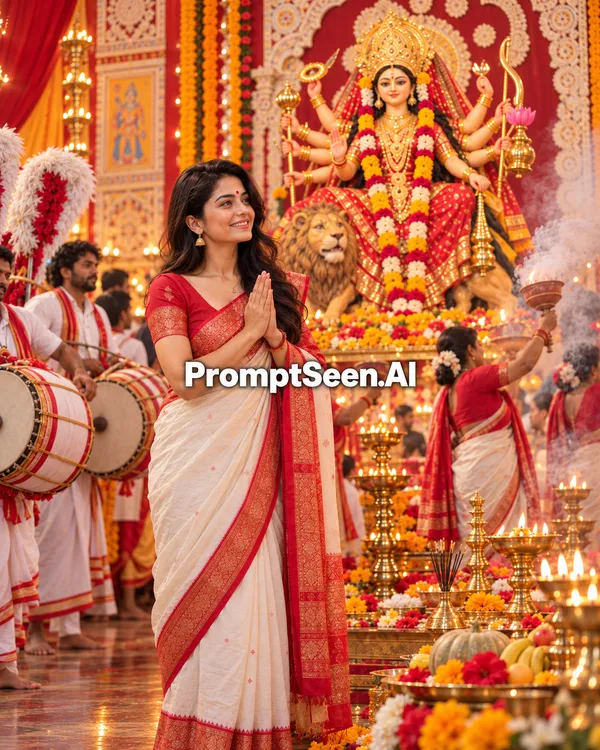
Immerse yourself in the rhythmic beats of Durga Puja. This Navratri AI photo prompt captures you standing amidst traditional dhaakis and dhunuchi dancers, offering an authentic Bengali pandal vibe during Maa Kushmanda's aarti.
Using the uploaded photo, keep the person's face, facial features, skin tone, hairstyle and body shape exactly the same. Do not alter the face in any way.
Create a realistic, candid photograph of this person in a traditional Durga Puja style Navratri pandal, standing in front of the idol of Maa Kushmanda during the evening celebrations. The person stands in the foreground in a slight three-quarter angle toward the camera, hands folded in prayer, with a joyful and devoted expression, fully immersed in the festive moment. Their face is clearly visible and sharp. They wear traditional Indian festive attire: a white saree with a red border (laal paar saree) or a dhoti with a silk panjabi kurta, with a red tilak on the forehead. The person is barefoot, with no shoes, sandals or slippers, as per Indian tradition in front of the deity.
Behind them stands a large, handcrafted clay idol (pratima) of Maa Kushmanda in the traditional Bengali pandal style: eight-armed, seated on a lion, holding a kamandal, bow, arrow, lotus, amrit kalash, chakra, gada and japa mala, wearing a red and golden saree, a gold crown and traditional shola and zari ornaments, with large expressive eyes, decorated with fresh marigold garlands.
On one side, two dhaakis in white dhoti and kurta play large dhaak drums decorated with tall white kaash feathers, mid-beat. On the other side, a few devotees perform the dhunuchi dance, holding clay dhunuchi pots with burning coconut husk and dhuno, and white fragrant smoke rises and drifts through the pandal. Brass diyas, conch shells and flowers are near the idol. The devotees in the background are softly blurred and also barefoot.
Photography style: shot on a DSLR with a 35mm lens at f/2.0, natural warm pandal lighting from lamps and diyas, smoke catching the light, shallow depth of field, sharp focus on the person's face, the idol, dhaak and dhunuchi clearly visible. Natural movement, real festival energy, natural skin texture, true-to-life colours, documentary Durga Puja photography look. Vertical 4:5 frame.
Avoid: smoke covering the person's face, glowing aura, halos, light beams, fantasy or divine effects, cartoon or animated look, CGI, over-smoothed skin, extra fingers, distorted hands, shoes, sandals, slippers or any footwear.
7. Maa Kushmanda Family Darshan Photo Prompt
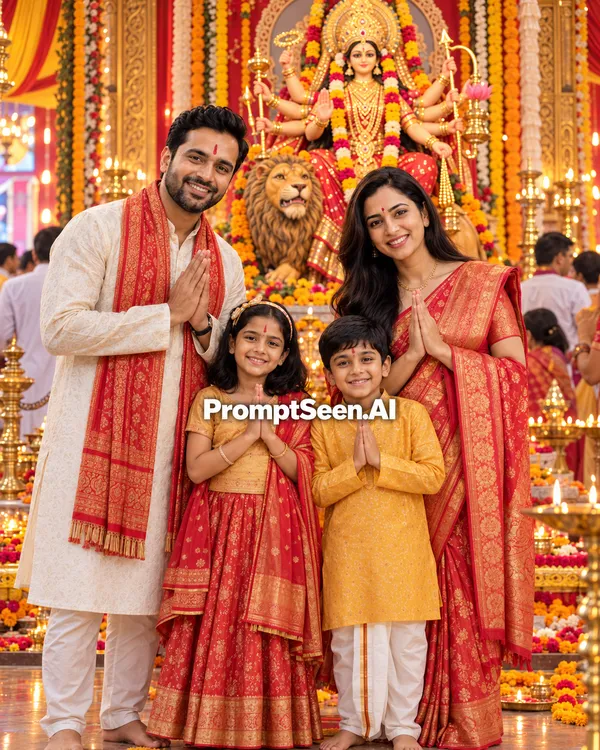
Celebrate devotion together. If you upload a family photo, this Durga Puja pandal photo prompt generates a beautiful, sharp group portrait of everyone standing respectfully barefoot in front of Maa's radiant idol.
Using the uploaded photo, keep every person's face, facial features, skin tone, hairstyle, age and body shape exactly the same. Do not alter any face. Keep the exact same number of people as in the uploaded photo; do not add or remove anyone.
Create a realistic family photograph of these people visiting a beautifully decorated Navratri pandal in India for darshan of Maa Kushmanda, like a cherished family memory photo taken by a professional photographer. The family stands together in front of the idol, naturally arranged: elders in the centre, others on both sides, and children in front. Everyone faces the camera with warm, happy and devoted smiles, some with hands folded in namaste. All faces are clearly visible and sharp.
Everyone wears traditional Indian festive attire in warm orange, red, yellow and golden tones: women in silk sarees or salwar suits with dupattas, bindi and simple gold jewellery; men in silk kurtas with dhoti or pyjama; children in small traditional ethnic outfits. Everyone has a red tilak on the forehead. Everyone is barefoot, with no shoes, sandals or slippers, as per Indian tradition in front of the deity.
Behind the family stands a large, handcrafted clay idol (pratima) of Maa Kushmanda: eight-armed, seated on a lion, holding a kamandal, bow, arrow, lotus, amrit kalash, chakra, gada and japa mala, wearing a red and golden saree, a red chunri, a gold crown and traditional jewellery, decorated with fresh marigold garlands. Brass diyas, incense sticks with soft smoke, flowers and a puja thali are placed at the foot of the idol.
The pandal has colourful fabric draping, marigold and mango-leaf torans, string lights and traditional decorations. A few devotees are visible in the background, softly blurred, and they are also barefoot.
Photography style: shot on a DSLR with a 35mm lens at f/4 so the whole family is in sharp focus, natural warm pandal lighting from diyas and lamps, the idol clearly visible and detailed behind them. Natural skin texture, true-to-life colours, warm festival family photography look. Vertical 4:5 frame (or horizontal 3:2 for a large family).
Avoid: changing or merging faces, extra or missing people, glowing aura, halos, light beams, fantasy or divine effects, cartoon or animated look, CGI, over-smoothed skin, extra fingers, distorted hands, shoes, sandals, slippers or any footwear.
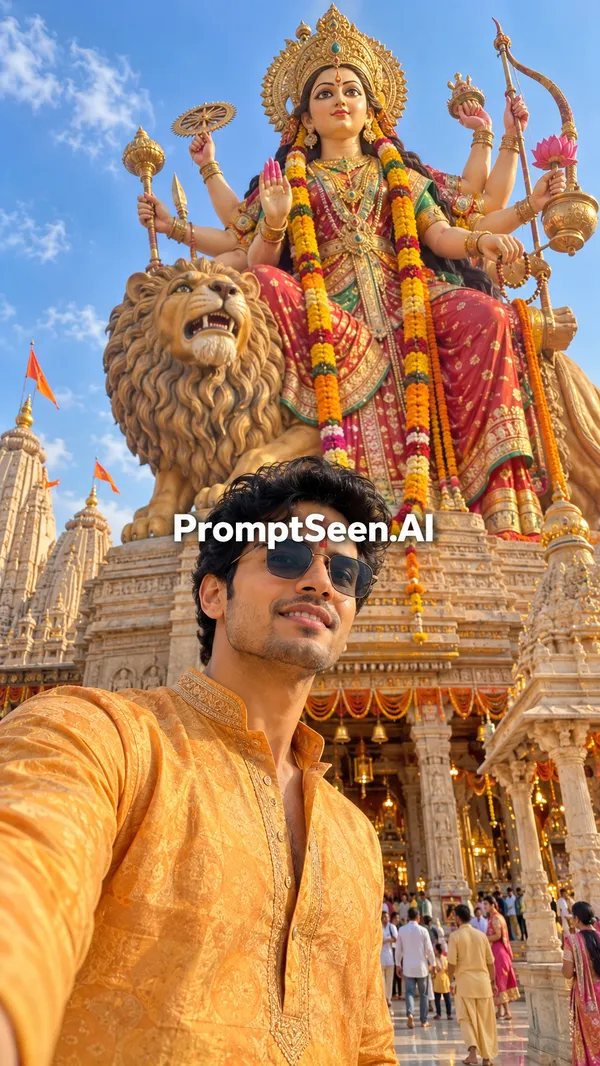
8. Maa Kushmanda 100 Feet Statue Selfie Photo Prompt (माँ कूष्माण्डा 100 फ़ुट मूर्ति सेल्फ़ी)
Capture an epic scale! This unique Gemini Navratri prompt creates a low-angle smartphone selfie where a towering, 100-foot stone statue of Maa Kushmanda on her lion rises majestically into the blue sky behind you.
Using the uploaded photo, keep the person's face, facial features, skin tone, hairstyle and body shape exactly the same. Do not alter the face in any way.
Create a realistic smartphone selfie of this person standing in the courtyard of a grand Indian temple, taking a low-angle selfie from below with a giant 100-foot statue of Maa Kushmanda towering behind them. The person holds the phone with one arm extended slightly above and in front of the face (the phone itself is not visible, as it is the camera), smiling happily with a sense of awe and devotion. Their face fills the lower part of the frame, clearly visible and sharp. They wear traditional Indian festive attire (a silk kurta or saree in warm orange, red or yellow tones) with a red tilak on the forehead. The person is barefoot, with no shoes, sandals or slippers, as per Indian tradition in the temple premises.
Behind and above them rises a massive 100-foot statue of Maa Kushmanda, seen from a dramatic low angle so it towers into the sky: eight-armed, seated on a giant lion, holding a kamandal, bow, arrow, lotus, amrit kalash, chakra, gada and japa mala. The statue is made of carved stone and painted in rich traditional colours, with a red and golden saree, a gold crown, detailed jewellery and a calm, compassionate face, with huge marigold garlands hanging from it. The statue stands on a tall carved stone pedestal.
The temple complex around it is grand and traditional: carved stone shikhara domes, pillared mandapas, saffron flags fluttering on top, brass bells, and a few devotees walking in the courtyard far below, small and softly blurred, also barefoot. Clear blue sky with soft clouds and warm late-afternoon golden sunlight falling on the statue.
Photography style: real smartphone front-camera selfie, wide-angle lens, low-angle perspective looking up, natural daylight, sharp focus on the person's face, the full statue clearly visible from the lion to the crown. Natural skin texture, true-to-life colours, slight natural wide-angle perspective. Vertical 9:16 frame.
Avoid: glowing aura, halos, light beams, fantasy or divine effects, cartoon or animated look, CGI, visible phone in hand, distorted face from the wide lens, over-smoothed skin, extra fingers, distorted hands, shoes, sandals, slippers or any footwear.
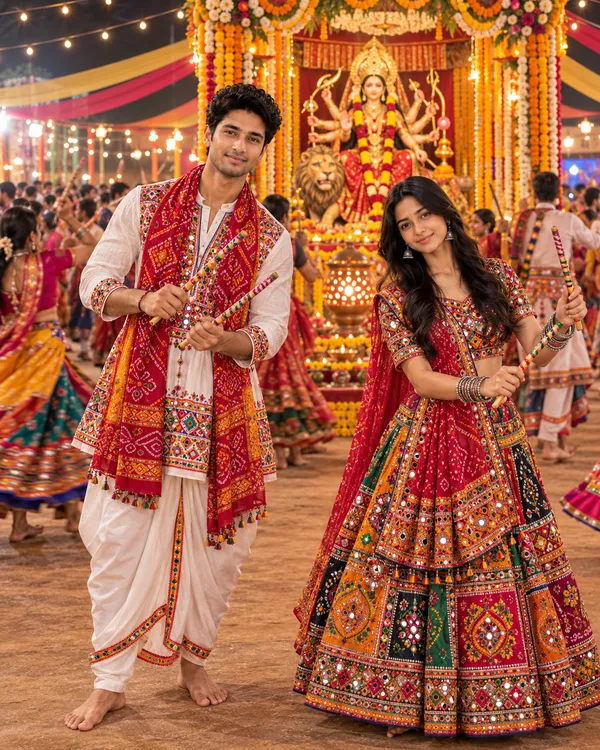
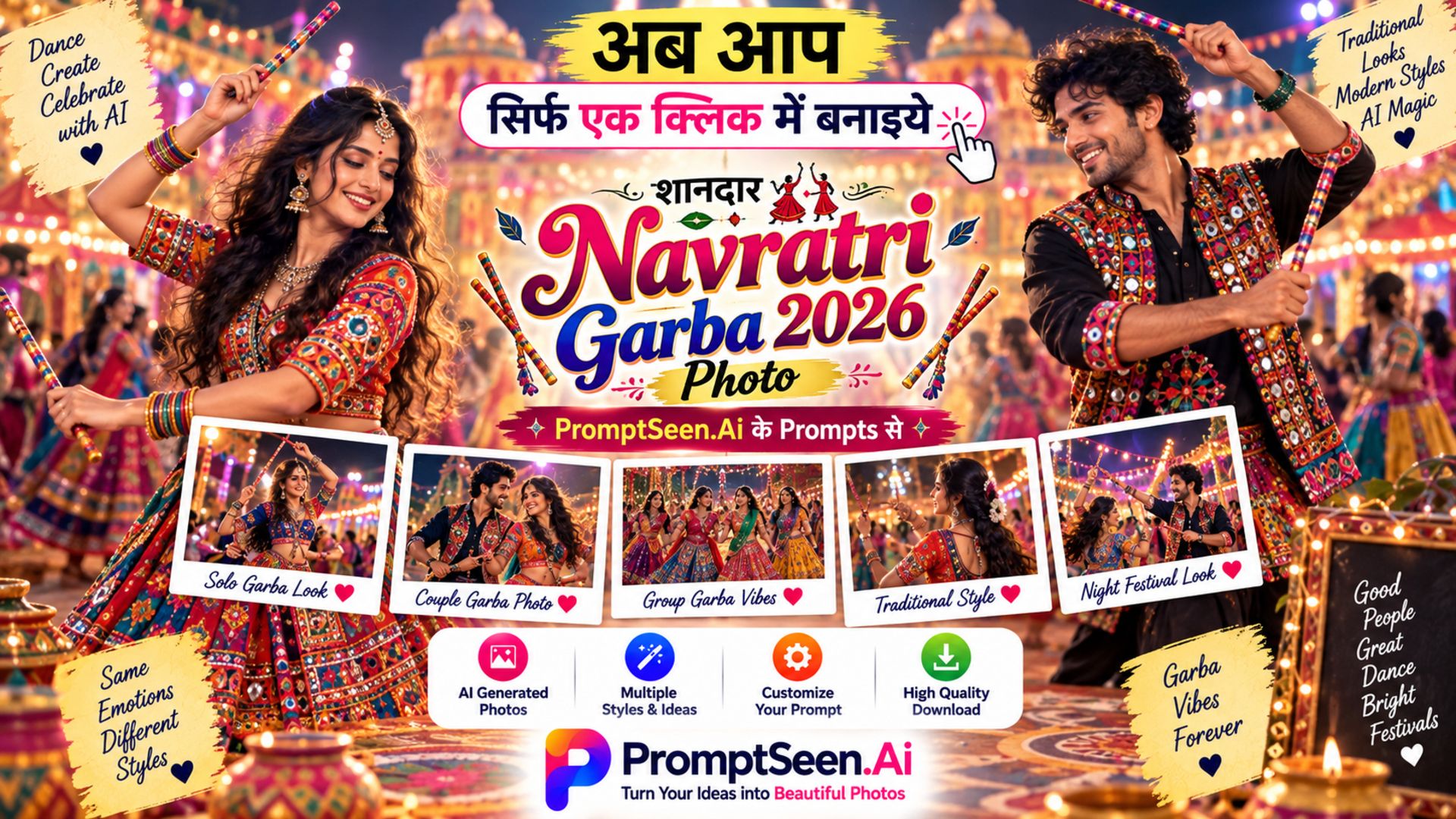
9. Maa Kushmanda Garba Night Photo Prompt (माँ कूष्माण्डा गरबा की रात)
Blend Gujarati tradition with deep devotion! This Navratri garba AI photo prompt styles you in a vibrant Chaniya Choli or Kediyu, holding dandiyas while dancing around the beautifully lit Maa Kushmanda garbi.
Using the uploaded photo, keep the person's face, facial features, skin tone, hairstyle and body shape exactly the same. Do not alter the face in any way.
Create a realistic, candid photograph of this person at a traditional Navratri garba night in India, standing in the foreground holding a pair of decorated wooden dandiya sticks, with a big joyful smile, in a slight three-quarter angle toward the camera. Their face is clearly visible and sharp. If the person is a woman, she wears a colourful mirror-work chaniya choli with a bandhani dupatta, oxidised silver jewellery, bangles and a bindi. If the person is a man, he wears a traditional embroidered kediyu with dhoti or churidar and a colourful bandhani safa or stole. The person is barefoot, with no shoes, sandals or slippers, as per the garba tradition around the Mataji sthapna.
In the centre of the garba ground is the Mataji sthapna: a decorated mandvi with a beautifully adorned idol (pratima) of Maa Kushmanda, eight-armed, seated on a lion, wearing a red and golden chunri, a gold crown and jewellery, decorated with marigold garlands. In front of the idol stands the traditional garbi, a perforated earthen pot with a lit diya inside, with small points of lamplight shining through its holes, surrounded by flowers and a puja thali.
Around the sthapna, groups of people in colourful traditional Gujarati attire dance garba in a large circle, mid-step, with dupattas and skirts flowing, slightly motion-blurred to show movement. A dhol player and string lights, colourful fabric canopies and marigold torans complete the festive atmosphere. Everyone dancing is also barefoot.
Photography style: shot on a DSLR with a 35mm lens at f/2.0, warm night lighting from string lights, lamps and the garbi, shallow depth of field, sharp focus on the person's face and dandiya sticks, the idol and garbi clearly visible behind them. Natural movement, real festival energy, natural skin texture, true-to-life colours, documentary Navratri photography look. Vertical 4:5 frame.
Avoid: glowing aura, halos, light beams, fantasy or divine effects, cartoon or animated look, CGI, over-smoothed skin, extra fingers, distorted hands, shoes, sandals, slippers or any footwear.
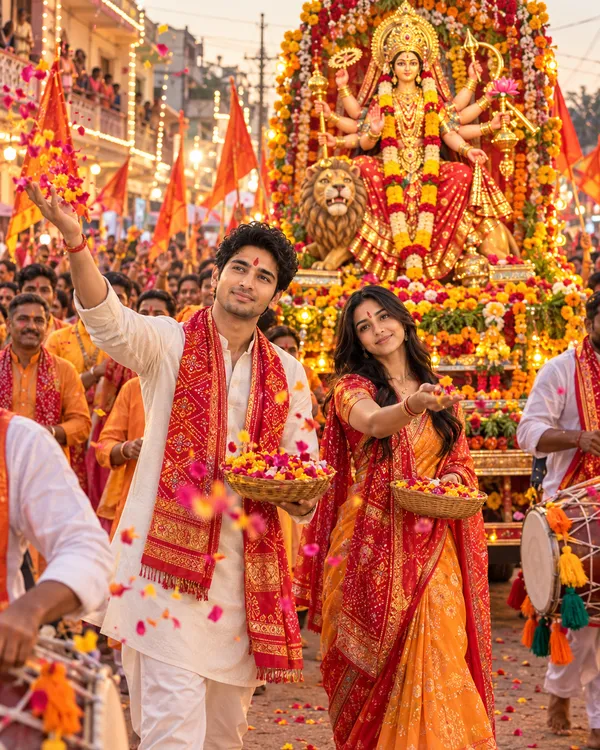
Welcome the goddess with joy! This highly energetic prompt frames you walking barefoot in a street procession, throwing marigold petals as the Maa Kushmanda idol arrives on a decorated trolley behind you.
Using the uploaded photo, keep the person's face, facial features, skin tone, hairstyle and body shape exactly the same. Do not alter the face in any way.
Create a realistic, candid photograph of this person taking part in the joyful aagman procession of Maa Kushmanda's idol on a street in an Indian town, as the idol is being brought to the Navratri pandal in the evening. The person walks alongside the procession in the foreground, in a slight three-quarter angle toward the camera, joyfully throwing fresh marigold and rose petals toward the idol with one hand raised, a big devoted smile on their face, mid-chant. Their face is clearly visible and sharp. They wear traditional Indian festive attire (a silk kurta or saree in warm orange, red or yellow tones) with a red tilak on the forehead and a red "Jai Mata Di" chunri-style stole around the neck. The person is barefoot, with no shoes, sandals or slippers, as devotees walk barefoot in the procession.
Just behind them, a large, handcrafted clay idol (pratima) of Maa Kushmanda rides on a decorated open trolley pulled slowly along the street: eight-armed, seated on a lion, holding a kamandal, bow, arrow, lotus, amrit kalash, chakra, gada and japa mala, wearing a red and golden saree, a red chunri, a gold crown and traditional jewellery, adorned with thick marigold garlands. The trolley is decorated with marigold flowers, mango leaves, red and yellow fabric and small lights.
Around the idol, a lively crowd of devotees in traditional clothes walks along, some with hands raised chanting, some throwing flower petals and a little red-orange gulal into the air. In front, dhol and nagada players beat their drums mid-motion, and a few people carry saffron flags. Flower petals float in the air. The street has old buildings, string lights and onlookers watching from balconies. The crowd behind is softly blurred, and devotees walking with the idol are also barefoot.
Photography style: shot on a DSLR with a 35mm lens at f/2.2, warm golden-hour evening light mixed with festive lights, flower petals frozen mid-air, shallow depth of field, sharp focus on the person's face, the idol clearly visible and detailed behind them. Natural movement, real festival energy, natural skin texture, true-to-life colours, documentary street festival photography look. Vertical 4:5 frame.
Avoid: gulal or petals covering the person's face, any written text or banners, glowing aura, halos, light beams, fantasy or divine effects, cartoon or animated look, CGI, distorted crowd faces, over-smoothed skin, extra fingers, distorted hands, shoes, sandals, slippers or any footwear.
Welcome to the 4th day of Sharad Navratri! As the festival deepens in devotion, devotees honor Ashtabhuja Devi, the creator of the universe. If you are looking to share your reverence on social media, simply downloading a generic Maa Kushmanda AI photo prompt is no longer enough. You need visuals that feel personal and deeply connected to your faith.
That is why we have crafted the ultimate collection of copy-paste Maa Kushmanda prompt templates. Engineered specifically for Google Gemini (Nano Banana) and ChatGPT's advanced image generation, these prompts allow you to upload your own selfie and instantly generate hyper-realistic, documentary-style devotional photos—from holding a Bhog Thali in a grand Durga Puja Pandal to dancing at a vibrant Garba Night.
12. Who Is Maa Kushmanda? (Navratri Day 4 Significance)
Worshipped on the fourth day (Chaturthi) of Navratri, Maa Kushmanda is celebrated as the creator of the cosmic egg (universe). According to Hindu mythology, when there was only darkness, she produced the universe with a mere flash of her divine smile. She resides in the inner core of the Sun, which is why she possesses a radiant, golden complexion.
Often depicted with eight arms (Ashtabhuja Devi) riding a fearless lion, she holds a kamandalu, bow, arrow, a jar of nectar (amrit kalash), discus, mace, rosary, and a lotus. Sharing a Navratri Day 4 Gemini AI photo prompt that respects this powerful imagery is the perfect way to seek her blessings for health, wealth, and strength.
13. How to Create Maa Kushmanda AI Photos in Gemini & ChatGPT
Creating your personalised devotional portrait is incredibly simple with our tools.
How to Use Maa Kushmanda Prompt in Gemini AI
Open Google Gemini and click on the image upload icon (+) in the chat bar.
Upload a clear, front-facing selfie of yourself.
Copy any Navratri prompt in english from the cards above (e.g., the 'Sandhya Aarti' prompt).
Paste it into Gemini and press enter. The AI will map your face onto the generated festive scene perfectly.
How to Use Maa Kushmanda Prompt in ChatGPT
Ensure you have ChatGPT Plus (which includes DALL-E 3).
Click the attachment icon and upload your reference photo.
Paste the माँ कूष्माण्डा प्रॉम्प्ट and instruct ChatGPT to "use my face exactly as shown."
14. How to Keep Your Face and Clothes Same in Navratri AI Photos
The biggest challenge with AI generation is losing your real identity. That is why every Maa Kushmanda photo editing prompt on this page starts with a strict "Identity Lock." Phrases like "preserve the person's exact facial identity, skin tone, hairstyle and body shape" ensure that you don't end up looking like a cartoon.
If you want to keep your exact clothes from your uploaded photo, simply remove the line in our prompt that dictates the attire (e.g., "wear traditional Indian festive attire") and replace it with: "keep the exact same clothing as worn in the uploaded reference photo."
15. Tips for Respectful and Realistic Navratri AI Photos
Always Barefoot: Notice how our Navratri AI photo prompt templates explicitly instruct the AI to render the subject barefoot ("no shoes, sandals or slippers"). This ensures cultural respect when standing before the deity.
Avoid the CGI Glow: We use extensive negative prompts like "Avoid glowing aura, halos, fantasy or divine effects" to make sure the photo looks like it was taken by a real DSLR camera in a real pandal, not a plastic-looking digital painting.
Gender and Age Neutrality: Whether you need a Prompt seen Navratri girl, a Navratri prompt for baby girl, or a Navratri prompt boy layout, the AI adapts the clothing (saree/chaniya choli vs. kurta/dhoti) based on the gender it detects in your uploaded photo.
16. FAQ – Maa Kushmanda Prompt
What is a Maa Kushmanda AI photo prompt?
A Maa Kushmanda AI photo prompt is a specific text command for tools like Gemini or ChatGPT that seamlessly integrates your face into a beautiful, realistic Navratri Day 4 pandal or aarti scene.
How to use a Navratri Day 4 Gemini AI photo prompt?
Upload your clear front-facing selfie to Google Gemini, copy any of the Navratri Day 4 prompts from our library, and paste it into the chat box to generate your realistic devotional portrait.
Can I use these templates as a Navratri prompt for baby girl?
Yes! The prompts are fully adaptable. Upload your baby girl's photo and use the 'Ghar Ka Mandir' or 'Mala Arpan' prompts for adorable, respectful Navratri portraits.
Are there specific Navratri prompt boy versions?
All our prompts are gender-neutral. Whether you need a Navratri prompt boy or girl, the AI will adapt the traditional festive clothing (like a kurta or dhoti) to match the uploaded person's identity.
How can I generate a Garba prompt for girl?
Use our specific 'Maa Kushmanda Garba Night Photo Prompt'. It places the user in traditional Gujarati attire holding dandiya sticks with the Mataji sthapna in the background.
Will the AI change my face in the Navratri prompt in english?
No. Our Navratri prompt in english templates start with a strict 'identity preservation' rule, ensuring your facial features, skin tone, and body proportions remain completely unaltered.
What are the 9 days of navratri?
The 9 days of navratri celebrate the nine forms of Maa Durga (Navdurga). Day 4 is dedicated to Maa Kushmanda, the creator of the universe, who resides in the core of the Sun.